This assignment asked students to critically evaluate an AI-generated history essay rather than passively accepting AI output as accurate. Students first prompted an AI tool to generate an essay, then annotated it for historical accuracy, use of primary sources, historical thinking, and complexity before revising it in their own voice and completing a reflection.
Click on each card to expand for details.
View Assignment in Canvas (Original Implementation)
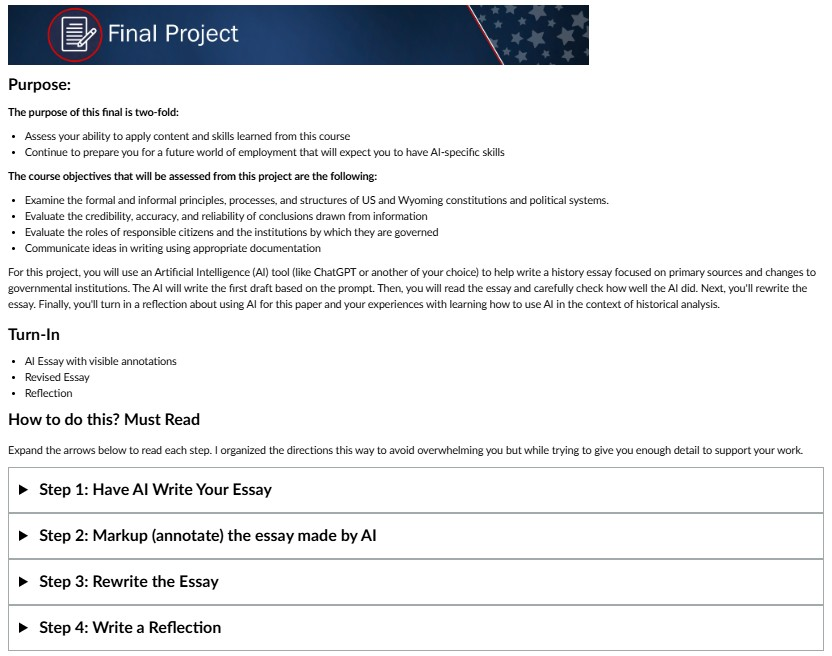
Original Canvas assignment showing chunked, expandable steps designed to reduce cognitive load while supporting a multi-stage analysis process.
The Challenge
Students were asked to do more than write an essay. They needed to evaluate AI-generated historical reasoning, identify factual and interpretive weaknesses, determine whether sources were real and appropriate, and then revise the work using their own judgment.
Because the task involved several layers of analysis, I organized the directions into expandable sections so students could focus on one step at a time instead of facing one long block of instructions.
Purpose and Learning Outcomes
This project served two goals at once: assessing students’ ability to apply course content and historical reasoning, while also preparing them to use AI critically in future academic and workplace settings.
Examine U.S. and Wyoming constitutional and political structures
Evaluate the credibility, accuracy, and reliability of information
Analyze the roles of citizens and institutions
Communicate ideas in writing using appropriate documentation
Assignment Structure
Generate an AI essay
Annotate the AI essay
Rewrite the essay
Write a reflection
Deliverables and Assessment
AI Essay with annotations
Revised Essay
Reflection
The rubric evaluates accuracy, use of primary sources, historical thinking skills, complexity of reasoning, revision quality, and reflection.
Design Rationale
The accordion structure was a deliberate cognitive-load strategy. It allowed students to move through a complex assignment in manageable stages without losing access to detailed guidance.
This assignment also made student thinking visible through annotation, revision, and reflection.
By embedding AI use within disciplinary analysis, the assignment positioned AI literacy as part of historical reasoning rather than a separate skill.